Masai Mara
Our first instructions for the tour was to pack a small bag for 2 nights in the Mara National Park. The rest of our luggage would be stored in our truck (named Limpopo, after a river) and we would travel into the Mara in minivans. Our van consisted of 4 couples and we dubbed it the 'Love Bus' as we had 2 couples on honeymoons, 1 newly engaged and ourselves who were soon to reach our 1yr anniversary. It took a few hours to drive from Nairobi out to the camp site and was a good opportunity to start to get to know the others in our van. It turned out that most of the people were from England which is a bit different from the other tours we have done around Europe.
The roads that we travelled on varied from OK to really bad. It was a sign of future roads to come with large rocks and lots of sand making up the start of roadworks. It was very noticeable when we left the wealthier areas in Nairobi. The houses became much simpler and were often little more than corrugated iron sheets and uneven planks of wood nailed together. The people were dressed in their finest clothes and setting off for the walk to their jobs. We don't know how their clothes managed to stay clean with all the dust that was around.
We had a brief photo stop at the Rift Valley on our way, just to try and appreciate just how vast the landscape is. Along the side of this windy road there were people cooking corn in 'ovens' dug into the side of the hill. They would then try and sell it to the cars driving up. 6 hrs after we left Nairobi we finally arrived at camp with the last 2hrs being the worst of the roads so far.
As our introduction to life on the campsite, this was really nice. It was a permanent tented camp site, so each tent had 2 single beds and a toilet and shower at the back. Luxury. However, we should mention that this camp didn't have any fences and there were a few monkeys hanging around when we got there. We had also seen some rather large deposits from elephants nearby. Some of the local Masai were used as guards to patrol the perimeter and keep us safe overnight. We had one issue being that the zip on the doors of our toliet & shower didn't close so the guards probably got to see more than they expected.

Another aspect of the luxury was that there was even electricity provided uptil 9pm. This meant that it was a race to get the few charging points for those that needed them. Luckily for us we had thought ahead and brought extra camera batteries.
In total we went on 2 half day safaris and a full day one. The first one was that afternoon. We had our first experience of what it meant to be a tourist in Africa as well. There was a group of Masai women at the gates of the reserve and the instant our van pulled up they were at the windows trying to sell us blankets, beads and carved animals. We learnt quite quickly after that to have the windows up. They also just run around the side of the gate in case you missed them the first time. At one point we thought the lady was going to crawl onto the roof and pass us stuff through the sun roof. 10 out 10 for effort!
On the game drives there seems to be no set rules for the drivers to follow, as they seemed to drive everywhere and anywhere. There are some dirt roads, but as soon as an animal is sighted it is straight onto the grass. The radio is also constant in the background as the drivers talk to each other. The roof of the van pops up so that when you do find the animals you can use the roof or the windows to take photos or video. We are still amazed at how capable our driver was at spotting animals. As our group had split into 3 vans, quite often all 3 would be together and then our driver would say, 'I think this way is better' and we wouldn't see the others for a few hours.
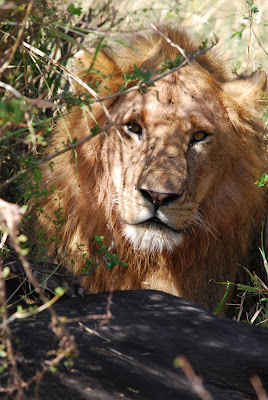
A slight delay in reaching the gate one morning. Flat tyre We had sighted some Giraffe and Zebra before we even reached the park and were very excited about our first game drive experiences. Each time we entered the park there were some more Zebra and Gazelle quite close to the gate. As we drove further we saw herds of Elephants that were feeding, and families of Giraffe going for a walk. One of the highlights was getting VERY close to a few Lions. As it turns out they don't move much and like to sleep through most of the day.

 A typical drive would involve bumping along the road scanning the horizon in the hope of seeing something. We often decided that far off trees looked like Elephants, when suddenly there would be excitement on the radio and we would pick up speed and turn up along with 10 other vans to see a lone Lion or Cheetah. Amazingly at times we were only 2 metres away from them. There seems to be an unwritten rule of only 5min with the animal before moving on and people get cranky if take longer.


 The most memorable moments from this park include:
- Driving through a heard of Buffalo. They definitely didn't seem at all concerned that we were there. As we slowly made our way through they would turn and look at us and usually move off the road. It was interesting to see the number of birds that were sitting on their heads and picking at the ears and noses.

- Observing a group of about 10 Vultures fighting over the remains of what we think was a Buffalo carcass. It was only the insides that remained and the 3 way tussle for the intestines made for tense viewing. There was also a couple of Hyena on the fringes waiting for their turn. We then realised that sitting in a nearby bush was a male Lion guarding Buffalo carcass. Interestingly we revisted this spot a few times over the next 2 days and the Lion did not move, but the Buffalo hadn't been eaten. We were told that the Lion would probably wait about 3 days before eating.


- Seeing the migration of Wildebeest and Zebra. There were 1000's of them and they all seem to travel in straight lines, follow-the-leader style. They travel together as both animals have complimentary skills. One has great eyesight, and the other has superior hearing so that they will detect predators first. The animals are in a constant migration pattern and move north from the Serengeti to the Mara and back again a few months later in search of fresh grasses. We were also able to see them cross the Mara River although at quite a distance. Not even Steve's super lens could manage a photo. The bush bathroom break was quite an interesting one with the Zebra moving past!


- Rescuing a van of Chinese tourists who had followed us when we took a 'short cut' through a dry creek with quite steep banks. Their driver wasn't quite as adventurous (or capable) as ours and struggled to make it up the other side. All the guys on our truck tried to push him up the bank but to no avail. In the end our van had to tow him out, although the rope snapped twice in the process. It would have been really nice if any of the fancy looking 4WD Landcruisers that came past gave a hand. So even though we got through fine, it took 45min to get the other van out and we were an hour late for lunch.

- Watching Monkeys steal bananas at the lunch spot and then discovering the Hippos at the riverside. Usually Hippos spend the day lazing in the water so it was lucky for us to see all of them on the riverbank. While watching them from the bridge we also saw a small crocodile in water.

We were also able to meet some of the Masai at their village. We were welcomed in dramatic fashion as they all started dancing and jumping right in our faces. They then took our hands and made us join in. Claire's new Masai friend gave her his blanket to wear and she didn't want to give it back. It was surprisingly soft. Later they performed the tradional 'Jumping Dance' which Steve joined into. Traditionally the highest jumper would be offered a wife as a prize. The locals didn't need to fear. We don't know how they do it but they certainly get very high. None of the tourists even came close.
 Performed by a professional
Performed by a professional 
Steve's turn, although to get the height Steve had to bend the knees.

The Masai village is fenced in thorn bushes to protect from the wild animals and the cattle are also protected in the same way. Each compound represents one family and the number of huts shows the number of wives of the chief. This village had 10 huts! Each hut is built by the wife from mud, grass and cow poo and maintained by the wife. The huts are quite small and very dark inside, but have separate areas for cooking, sleeping and keeping the baby animals. The central area of the village is also littered with cow poo as this is where the cattle aer kept overnight to protect them from the wildlife. While we were there we could see the cattle returning, usually with quite a young boy in charge of the herd. They have to travel many miles to find suitable grazing for them.
Close encounter with a few of the kids. The one in pink was fascinated by the earings. 

We left the Mara looking forward to the rest of the trip. The drive back to Nairobi was interesting. Claire got to see first hand the true condition of the road as she sat in the front seat. It wasn't uncommon for the driver to change sides of the road if he thought that side was better.
Back just outside Nairobi at 'Karen camp' we discovered how life would really be for the next few weeks. Our tents were already put up so all we had to do was sort out a shower and find some clean clothes. Being a participatory tour this was our first night of helping with the cooking and cleaning. Steve was on the cooking team and helped to create Coca Cola Chicken which is a specialty of our Zimbabwean driver and quite tasty. Claire was lucky as she was on Truck cleaning - nothing to do as we hadn't been in the truck yet.
Kenya was definitely memorable and we were looking forward to Tanzania and more game drives.


 After lunch we braved the street again and headed into town to see the National Archive. After the morning walk Claire had noticed that none of the women wore much jewelry so the wedding rings were removed. There were alot more people about in the afternoon and it took us an hour to weave our way around the sidewalk stalls selling mobile phones as well as the takeaway chicken places. Nearly every shop/stall has very loud music blaring out of it and makes for an interesting atmosphere. The Archive was really good. Each of the Kenyan tribes has a section and it is filled with weaponry, pottery, artwork, carvings and explanations of their lives. If you only had time to choose one I would return to the Archive. The staff were also very helpful and you could have paid for a tour guide as well.
 That night we met our tour guides and fellow passengers for the next 43 days on our Acacia Africa - 'Nairobi to Cape Town' tour. It was at the meeting that we discovered that we would be changing vehicles and getting new tour guides/group for the last 20 days. The group was a good mix with ages ranging from 21 to 40 and singles, friends, and couples.


 Dinner that night was at a traditional restaurant where we tried Gozleme. This was one of our favourite foods of the trip. They are a savoury pancake that can be filled with meat or cheese or spinach. More often eaten as a snack, we chose 4 and made it a meal. In all the places where we saw these being made it was done by an elderly lady. The best part of the meal was the massive hunk of watermelon that we bought on the way back to the hotel.


 Another of our highlights was a visit to a local potter. The guy made a plate out of the white clay for us and then a teapot out of the red. We can't remember what the difference was because they all get painted anyway. His work was very impressive and again we bought a few pieces. There was a Turkish Carpet shop across the road from our lunch stop so we had another go at bargaining and we finally made a deal. Steve even managed to get the carpet to fit into his backpack for the trip back to London and it is now safely in Brisbane, awaiting the perfect coffee table.
  The afternoon was spent in an underground city of Derinkya. We were able to go 8 levels down and were amazed at where the schools, animal pens, ventilation shafts, living areas and churches that had been created in the previous centuries. What was also amazing is that 8,000 people lived down there during times of war.

 That night we stumbled into a real wedding party that was happening across the road. Claire and Mary were ushered into the married ladies section while Steve and Darryl managed to located the brides father and get an explanation of procedings. It turns out that it was 'womens night' where the bride was getting henna tattooed. There was a stage set up with a group of girls dancing with the bride, although as we found out it is only the single ladies that can dance. The married women all surround the stage and then the men stand behind and choose who their future wife from those dancing. We were made very welcome and even offered food. It turned out that the actual ceremony was the next day at the grooms village. We noticed on our way past the next morning that the entire area was spotless and no evidence that 400 people had been there a few hours earlier!

 Istanbul